Journalists & Authors
Need: A fast and citable way to make a number land.
We > Ultrarich has transparent formulas, sources, and methodology. If our tool’s built-in values don’t match your need, you can query our API to get bespoke results.
We > Ultrarich turns abstract billionaire and trillionaire fortunes into comparisons readers can feel. We built it for journalists, advocates, educators, and developers. The content on our site is free to quote, embed, and republish — anywhere, including commercial publications. Just credit us.
Do you need to communicate about wealth or wealth inequality (a single fortune, a state's billionaires, or a proposed tax)? No matter how the people you’re trying to reach best understand large amounts of money, we’ve got you covered.
Need: A fast and citable way to make a number land.
We > Ultrarich has transparent formulas, sources, and methodology. If our tool’s built-in values don’t match your need, you can query our API to get bespoke results.
Need: A compelling and tangible way to contextualize wealth.
We > Ultrarich anchors results to real-world scale references. If our share cards or visual design don’t work with your branding, you can create your own by using our API.
Need: A classroom-ready tool without fees, ads, or tracking.
We > Ultrarich helps students make sense of large numbers in a fun way. If you’re teaching math, economics, sociology, or programming, there's a ready-made activity for you.
Need: An API to build your own visualizations and tools.
We > Ultrarich is CORS-enabled, has JSON responses, and is fully documented with an OpenAPI spec. If you have a question or need help, you can contact us.
We > Ultrarich — a public-interest project operated on a noncommercial basis — presents billionaire and trillionaire fortunes in tangible expressions and personalized comparisons. Each result is rendered as a shareable color-coded card, and is also available through a free, no-auth API + MCP server designed from the outset for both human and agent reuse. Our results and content are CC BY 4.0, ad-free, and paywall-free. Learn who we are, why you can trust our numbers, and how we're different from other wealth visualizers on our About page.
Wealth is expressed through four lenses.
How long would your or their money last?
How high would your or their wealth stack?
How many items could you or they pay for?
How much would your or their wealth grow?
| Website |
https://wegtultrarich.org/ Sources & Formulas Published in the FAQ |
|---|---|
| API with MCP |
https://api.wegtultrarich.org/ Docs at /README.md and /openapi.yaml |
| Content License | CC BY 4.0 |
| Maker |
Blonde Rocket Scientist LLC Human-Crafted with AI-Assisted QA Testing |
| Contact | info at wegtultrarich dot org |
In the homepage comparison tool, pick wealths and a comparison type then share the color-coded card (includes a call-to-action, hashtags, and link).
Below, pick wealths and a comparison type then copy/paste the code into one of your pages (works anywhere an iframe is allowed).
Create custom wealth expressions and comparisons through GET https://api.wegtultrarich.org/v1/....
Building with AI agents? Our MCP server lets Claude, ChatGPT, and other assistants call our comparisons as native tools (with source attribution built into every result). Connect your assistant to our MCP endpoint or call our API directly (view README.md or our other API documentation for details).
Our collections are public on Postman. Fork them, send the requests as they are, or change the numbers and see what comes back — there's no key to request and no account to create.
Also in our workspace are the full REST API reference and MCP requests for all five agent tools.
"The Ledger" is an interactive comparison tool that Claude created on its own initiative when connected to our MCP server. Every figure, sentence, and scale line in it comes directly from our API (as does the source attribution). That's the point of our infrastructure — when an AI assistant uses We > Ultrarich, the math is deterministic and the credit is built in.
Note: Tap Image To Open Live Interactive Demo
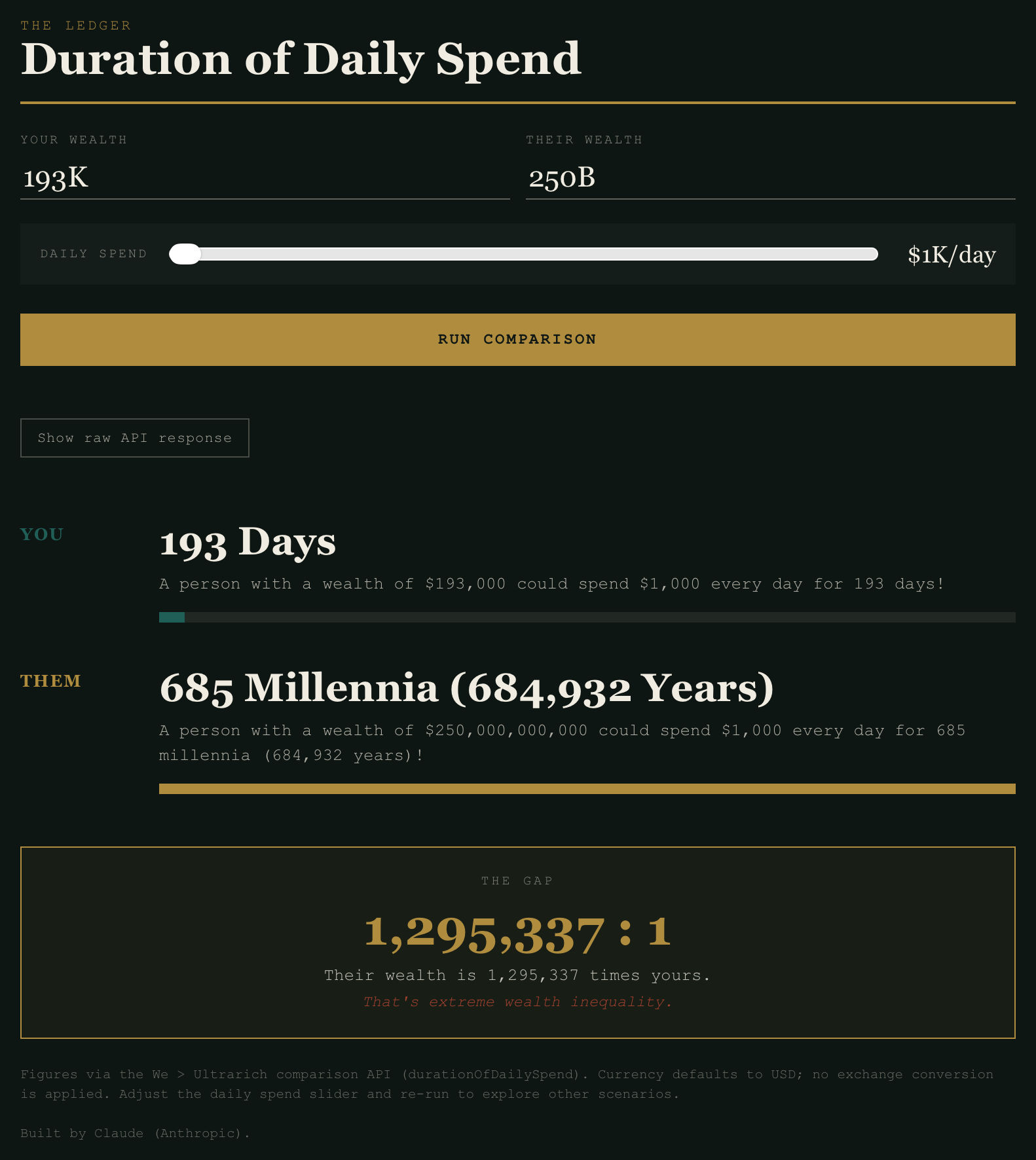
Pull factoids and calculated results from our comparison tool or companion API to use in your own work. One line of credit is all we ask — on quotes, embeds, and republished images.
Source: We > Ultrarich (wegtultrarich.org).
Write it as We > Ultrarich (or We Are Greater Than The Ultrarich where > won't work). Use wegtultrarich in identifiers. Full guide in LICENSE.md.
There are 3,428 billionaires worth a combined $20 trillion or more, and each of the top 20 holds at least $100 billion.
Source: Forbes World's Billionaires List, March 2026
At least 556,850 ultra-high-net-worth individuals and families each hold $30 million or more.
Source: Altrata World Ultra Wealth Report 2026
By many measures, U.S. wealth inequality now exceeds the levels of the Gilded Age.
Source: Inequality.org (Institute for Policy Studies)
On 12 June 2026, the world recorded its first trillionaire — a status that swings with the stock market (it was lost again on 24 June).
Source: The Associated Press
Note: Our dataset — wegtultrarich-wealth-figures — describes the extreme-wealth data and sources that fuel our comparison tool, API, and MCP server. Concept DOI (which always resolves to the latest version): https://doi.org/10.5281/zenodo.21444830. View our Extreme-Wealth Data page to learn more.
$1 trillion, spent at $1,000 a day, would last 2,739,726 years — far longer than humans have existed.
Source: We > Ultrarich (wegtultrarich.org).
$100 billion in dollar coins would stack 124,274 miles high — roughly halfway to the moon.
Source: We > Ultrarich (wegtultrarich.org).
$1 trillion could buy 2 million homes worth $500,000 — approximately 1.4 times enough for every person in San Diego.
Source: We > Ultrarich (wegtultrarich.org).
At just 1% interest, $100 billion grows by $1 billion a year — without anyone lifting a finger.
Source: We > Ultrarich (wegtultrarich.org).
California's Proposition 40, being voted on in November, is a one-time tax of up to 5% on certain taxpayers with covered assets over $1B. Though the state's Legislative Analyst's Office projects tens of billions of dollars spread over several years, Boll, Saez, and Zucman estimate it could raise about $100B over five years (Sources: Legislative Analyst's Office1 & Boll-Saez-Zucman NBER Working Paper 352182). In hundred-dollar bills, that amount would stack 68.35 miles or 110 km high — about 1.1 times the distance to the edge of space (Kármán Line).
Source: We > Ultrarich (wegtultrarich.org).
The reintroduced federal Ultra-Millionaire Tax Act of 2026 would raise an estimated $6.17 trillion over the next decade (Source: Saez–Zucman Scoring Letter3, 2026). In hundred-dollar bills, that amount would stack 4,217 miles or 6,787 km high — about 33.9 times the distance of a roundtrip to the edge of space (Kármán Line).
Source: We > Ultrarich (wegtultrarich.org).
We > Ultrarich, designed from the outset for both human and agent reuse, presents billionaire and trillionaire fortunes in tangible expressions and personalized comparisons. Its goal is to make the scale of extreme wealth inequality easily comprehensible, shareable, and a spur to action.

<img src="https://wegtultrarich.org/wordmark-wegtultrarich.svg" alt="We > Ultrarich (dark-vermillion text with bright-vermillion greater than sign)" aria-label="We Are Greater Than The Ultrarich" />
<img src="https://wegtultrarich.org/wordmark-white-wegtultrarich.svg" alt="We > Ultrarich (slightly transparent white text with bright-white greater than sign)" aria-label="We Are Greater Than The Ultrarich" />
Use our wordmark to credit us — not to imply we endorse or verify your work.
For press and media inquiries, reach out to Blonde Rocket Scientist LLC at info at wegtultrarich dot org. We respond quickly to deadline requests.
We > Ultrarich is classroom-ready. It's free. No logins, no accounts, no ads, and no student data collected (see our Privacy Policy). It runs in any browser, phones and Chromebooks included, so there's nothing to install. Published figures, explanatory text, result graphics, and API/MCP outputs are CC BY 4.0 — you can copy results into worksheets, slides, or your LMS with one line of credit.
Source: We > Ultrarich (wegtultrarich.org).
We > Ultrarich's content and tools can be used to support several learning goals. Below are four ready-made classroom activities for different education levels.
Estimate, Then Check
(10–15 Minutes, Warm-Up For All Levels)
Before opening the tool, students write down how long they think $1 billion would last at $1,000 a day. Then they run the comparison and compare answers. Discussion: Why does intuition break down past a million?
Compare & Cite
(30–40 Minutes, MS/JHS/HS)
Pairs of students pick a fortune and a familiar amount (median household income, a teacher's salary, the district budget, etc.), then choose a comparison type and write one sentence using the result plus our credit line "Source: We > Ultrarich (wegtultrarich.org)." Sharing Exercise: Which comparison type made the number land hardest, and why?
Follow A Number
(45 Minutes, HS/College/University)
Students trace a figure back to its source (Forbes Billionaires List, Federal Reserve SCF, etc.) using the formulas and footnotes in our FAQ, then discuss what a net worth estimate can/can't claim and examine this site's own point of view. Media-Literacy Exercise: Which parts are computed, and which parts are framing?
Call The API
(30–60 Minutes, CS)
Students make their first GET request to https://api.wegtultrarich.org/v1/..., parse the JSON, and then chart the results. No API keys, no signup — a clean first API exercise. Assessment: Evaluate the architecture of these API endpoints and the quality of their documentation.
The expressions and comparisons on our website are cached, so an entire class can load them at once. Custom API comparisons, however, are rate-limited per minute per IP — thirty devices behind one school network counts as one IP — so for whole-class custom queries, work in pairs or stagger requests.
We advocate for reducing extreme wealth inequality, and we say so plainly (read more on our About page). You might want to know that before you assign anything of ours, so we're telling you here rather than letting you discover it later.
We don't endorse any measure, campaign, candidate, or party — and we never will. The site's own call to action lives on pages a student needn't ever visit.
Every figure is deterministic arithmetic from cited public sources with published formulas... which is to say the numbers are checkable, and we'd rather a student checked them than took our word. Use the comparisons as pure numeracy work if that's what your course needs.
If you'd rather skip our framing entirely, our free API and MCP server return computation only — figures, sentences, and ratios with an attribution line. The only exception, which we state here up front, is that ratios at or above 200:1 are described as extreme wealth inequality. That 200:1 threshold is ours. It's a rounded contextual figure informed by a reported global disparity of roughly 190:1. It is not an official IMF definition and shouldn't be cited as one. Every other number in the response is arithmetic your students can check.
And, if you'd rather lean in, our point of view is itself a usable teaching moment. Ask students which parts of a comparison are computed and which are editorialized, and why the same true number can be made to feel large or small depending on what it's set beside. That's a media-literacy exercise we built the "Follow A Number" activity around.
With the U.S. midterms approaching, California's billionaire-tax measure on the November ballot, and a federal wealth tax back in play, extreme wealth is on the agenda and in the public conversation. We > Ultrarich makes the scale of that wealth — and the inequality it represents — immediate, personal, and shareable.
Note: We > Ultrarich is not affiliated with, and does not specifically endorse, any single measure, campaign, candidate, or party. We advocate for the cause of reducing extreme wealth inequality, and leave specific choices and actions to you and your elected officials.
Contact us at info at wegtultrarich dot org.
Last Updated 13 September 2026